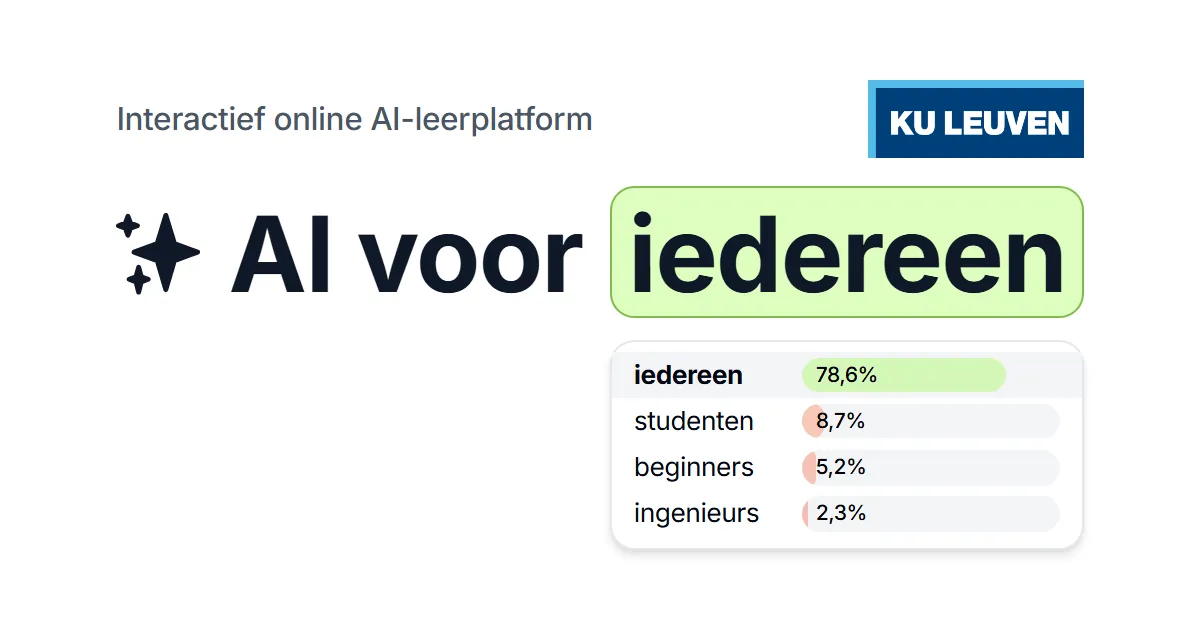
AI voor Iedereen (“AI for Everyone”) is an interactive online course on how artificial intelligence works under the hood, from the search algorithms in a GPS to the large language models behind ChatGPT. Every chapter builds intuition first, through everyday examples and interactive demos such as this one, which shows what a language model weighs up while it writes a sentence:
The mathematics behind each technique comes after that intuition, as an optional layer for the readers and courses that want it, together with Jupyter notebooks to apply the techniques in Python. The platform is open to the general public too: anyone who wants to learn about the broad field of AI can use it, for free and without an account.
I designed and built the platform at KU Leuven and wrote its content and demos, working with Tinne De Laet and Luc De Raedt, with the support of the Leuven.AI institute and the Faculty of Engineering Science.
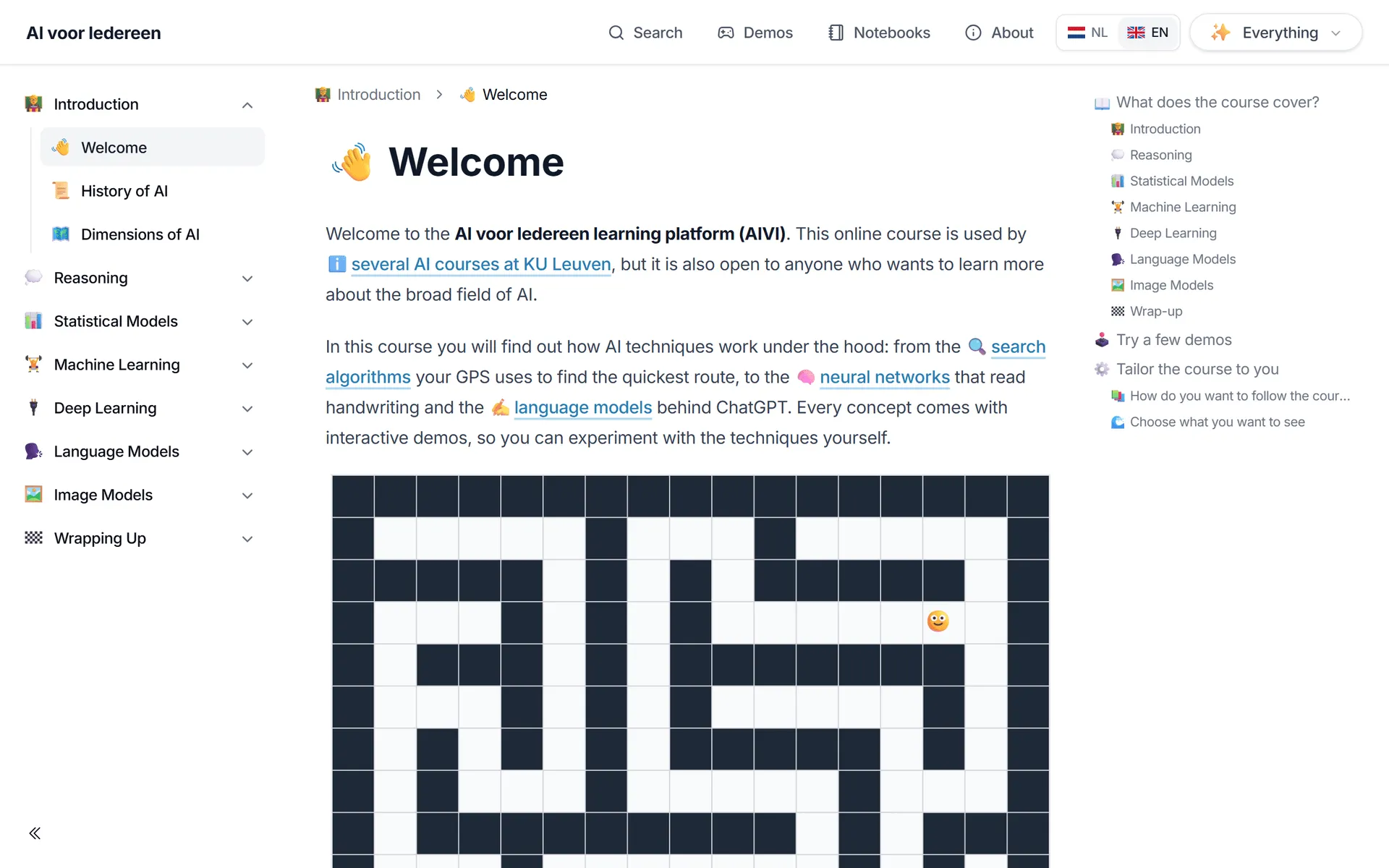 The welcome page of the English edition, with a search algorithm solving a maze live.
A shared base for every “AI for X”
Many faculties want an AI course of their own, an “AI for X” such as AI for architects or AI for linguists. Rather than every professor preparing slides and lectures on the same fundamentals, such a course selects the chapters it needs from the platform as a shared online part of two credits. Students work through it at their own pace, or at a pace the professor sets, and the rest of the course’s credits go to what AI means in that field.
What began as one elective now works this way for several KU Leuven courses: AI voor Iedereen, AI voor Letteren, AI voor Architecten and the English-taught master’s course AI for Engineering Science, with more on the way. I teach AI voor Iedereen and AI for Engineering Science myself, as a guest professor, and for the engineering course all chapters, demos and notebooks are now also available in English.
Few Dutch-language courses go deep enough into the whole field of AI while staying accessible, and even internationally few courses have this many interactive demos, although they are what make it possible to explain AI through intuition instead of formulas. As Belgium’s largest university, with the country’s largest AI research group, KU Leuven had good reason to build such a course, for its own students as well as for the general public.
What the course covers
The course opens and closes with an overview of the whole field. In between, each chapter takes on one technique, following the four historical waves of AI before moving on to two application domains:
- 🧑🏫 Introduction: 📜 History of AI, 🗺️ Dimensions of AI
- 💭 Reasoning: 🔍 Search algorithms, 🧭 Heuristic search, ♟️ Game trees, 🧩 Logic
- 📊 Statistical models: 🎲 Probability, 🕸️ Bayesian networks
- 🏋️ Machine learning: 👶 Naive Bayes, 🏘️ Nearest neighbors, 🛡️ Support vector machines, 🌳 Decision trees, 📈 Regression, 🫧 Clustering
- 🔌 Deep learning: 🧠 Neural networks
- 🗣️ Language models: 📱 Autocomplete, ✍️ Large language models
- 🖼️ Image models: 👁️ Convolutional neural networks, 🖌️ Diffusion models
- 🏁 Wrapping up: 🏅 Model evaluation, 🥊 AI challenges, 🌍 Societal impact of AI
Intuition first, depth on demand
A chapter typically opens with a concrete problem, such as drawing up a class timetable or telling spam from genuine email, before it names the technique that solves it. Plain-language explanations, examples and demos then build up that technique step by step, followed by where it works well and where it breaks down. This core assumes no more than secondary-school maths.
On top of that core come three layers that you can switch on or off:
- 💡 Maths refreshers: short explanations of the school maths a chapter relies on, such as functions or the summation sign.
- 📐 Mathematical deep dives: the formal side of each technique, from its derivations to its loss functions. More technical courses such as AI for Engineering Science switch these on by default.
- 💻 Programming: twelve Jupyter notebooks that apply the techniques to real problems and open straight in Google Colab.
Students who pick their course see exactly the chapters and layers it requires, and other readers choose their own mix.
Three of the notebooks, from route planning on a real map to an agent that plans your train ride to class:
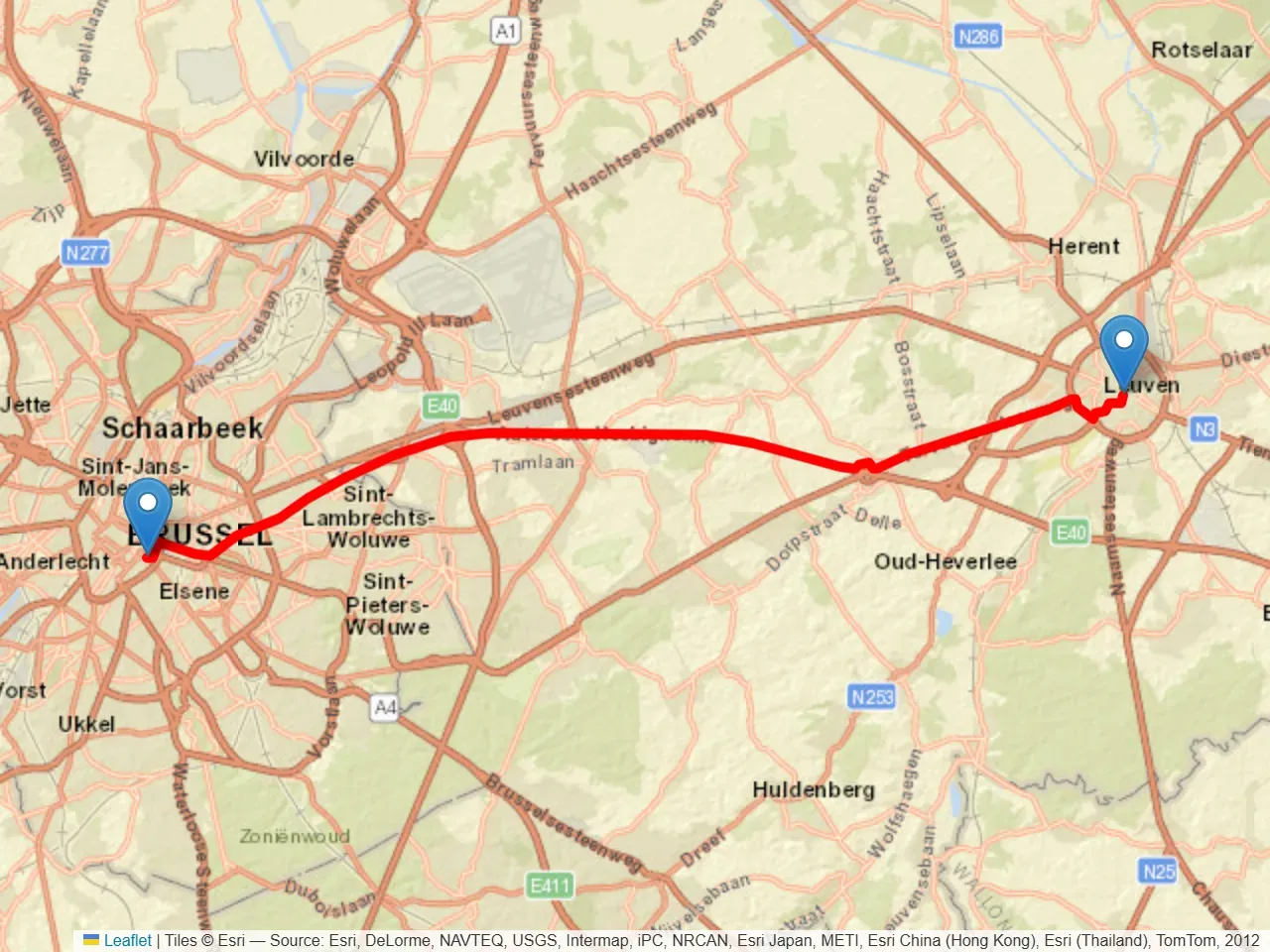
An implementation of A*, applied to a word ladder and to a real route between two places on OpenStreetMap.
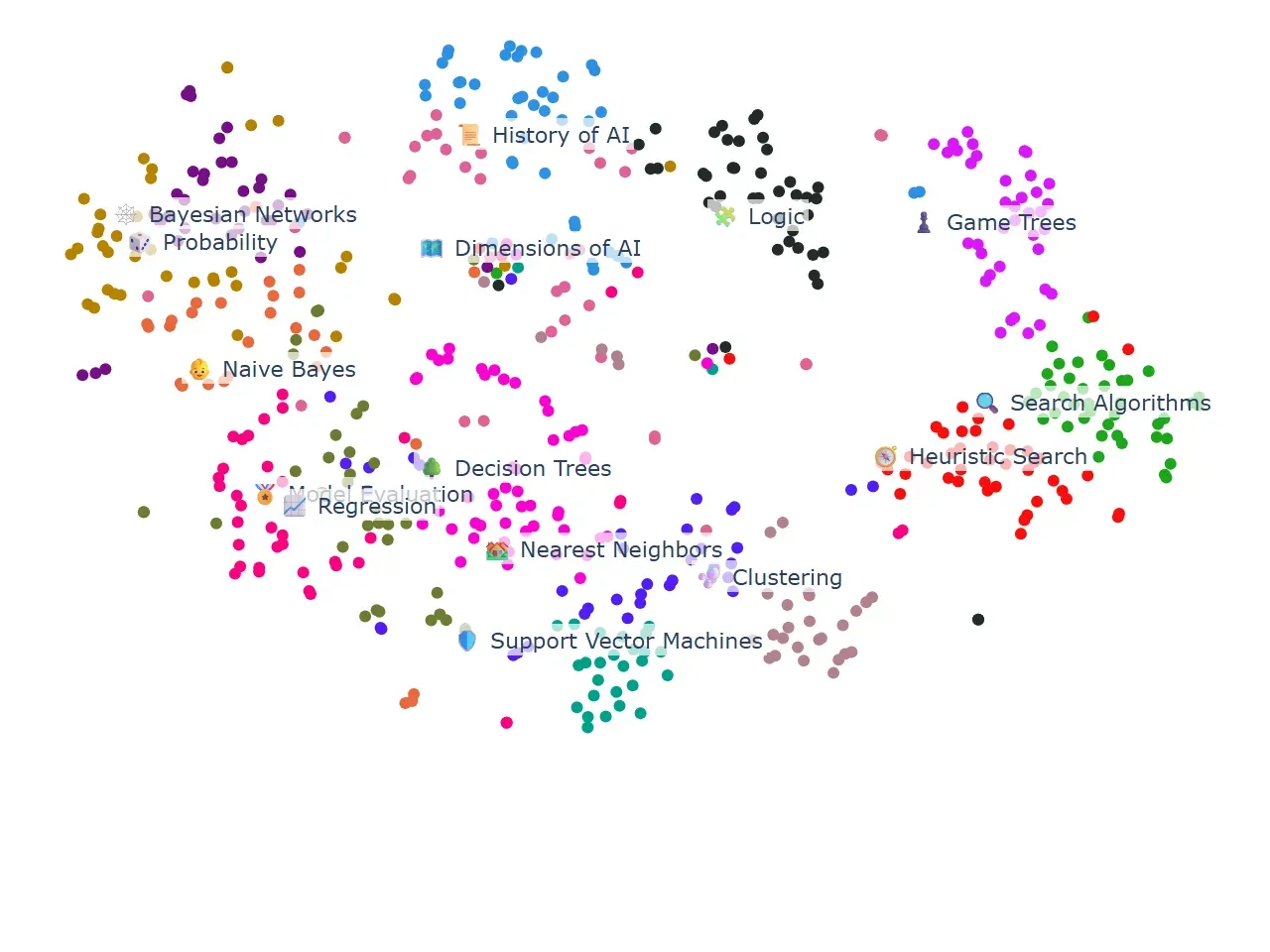
Sentences become numbers and this course becomes data: a map of all its sections, topics that clustering finds on its own, a search engine that searches on meaning, and a study assistant that looks things up in the course before it answers.
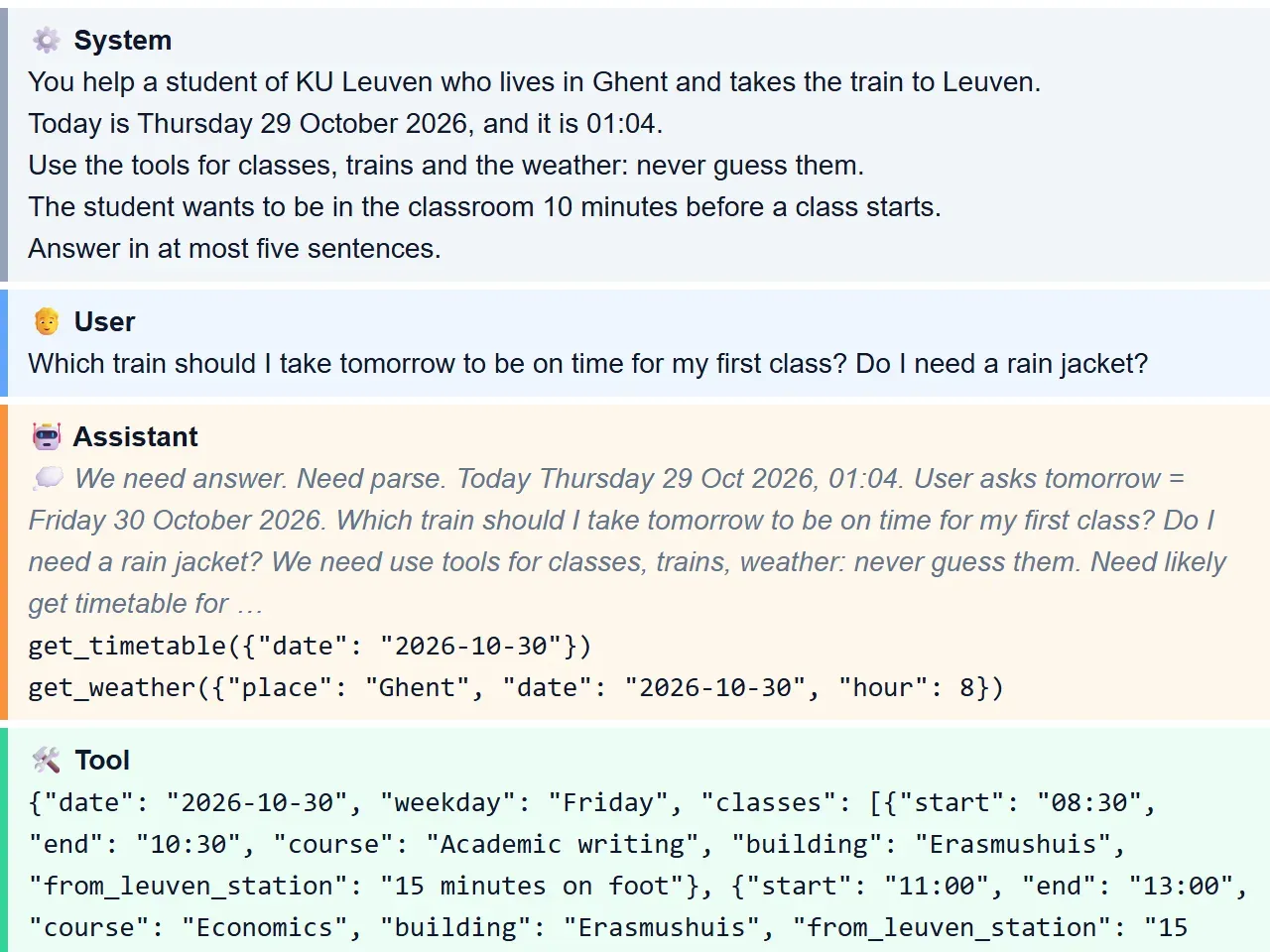
Call a free language model from Python, and make it an agent that plans which train takes you to your first class, with the live train times, the weather forecast and your timetable.
Play the algorithm yourself
The platform has more than seventy interactive demos. Rather than only reading about an algorithm, you get to be the algorithm: drag sliders, edit the dataset, draw an input and watch the model respond in real time. You can sketch a digit and watch a neural network fire its way to a guess, play Connect Four against a minimax algorithm, place bike-sharing stations with k-means, or follow a search algorithm as it explores a maze. Most demos come back throughout their chapter, gaining options as the concept they illustrate grows.
👉 Explore it yourself at ai.kuleuven.be/aivooriedereen, or go straight to all the demos.