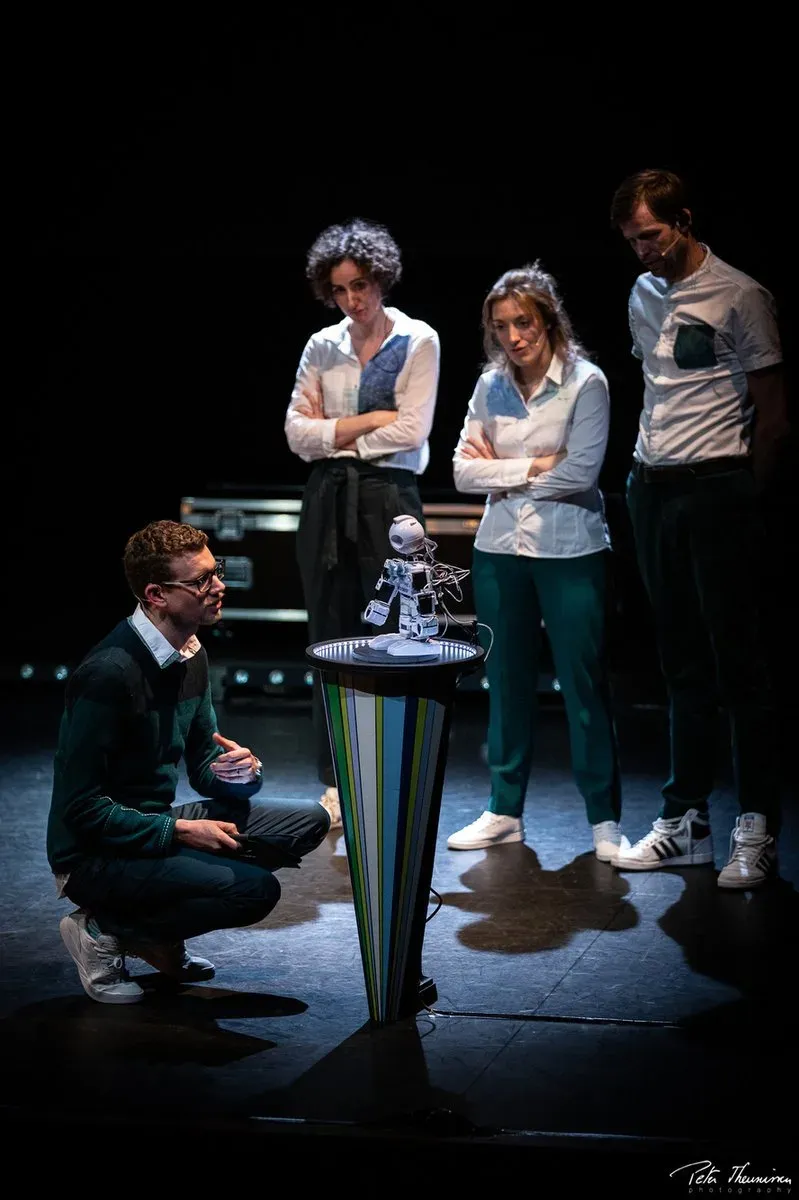









Sneak peek at the costume design of #Improbotics Flanders, to premiere in one month! Lotte Cools is doing an amazing job. #ERLNMYR @improbotics is artificial intelligence performing improvised theatre, with a robot as your host! #scicomm #sciencetheatre pic.twitter.com/LO4IG34PVO
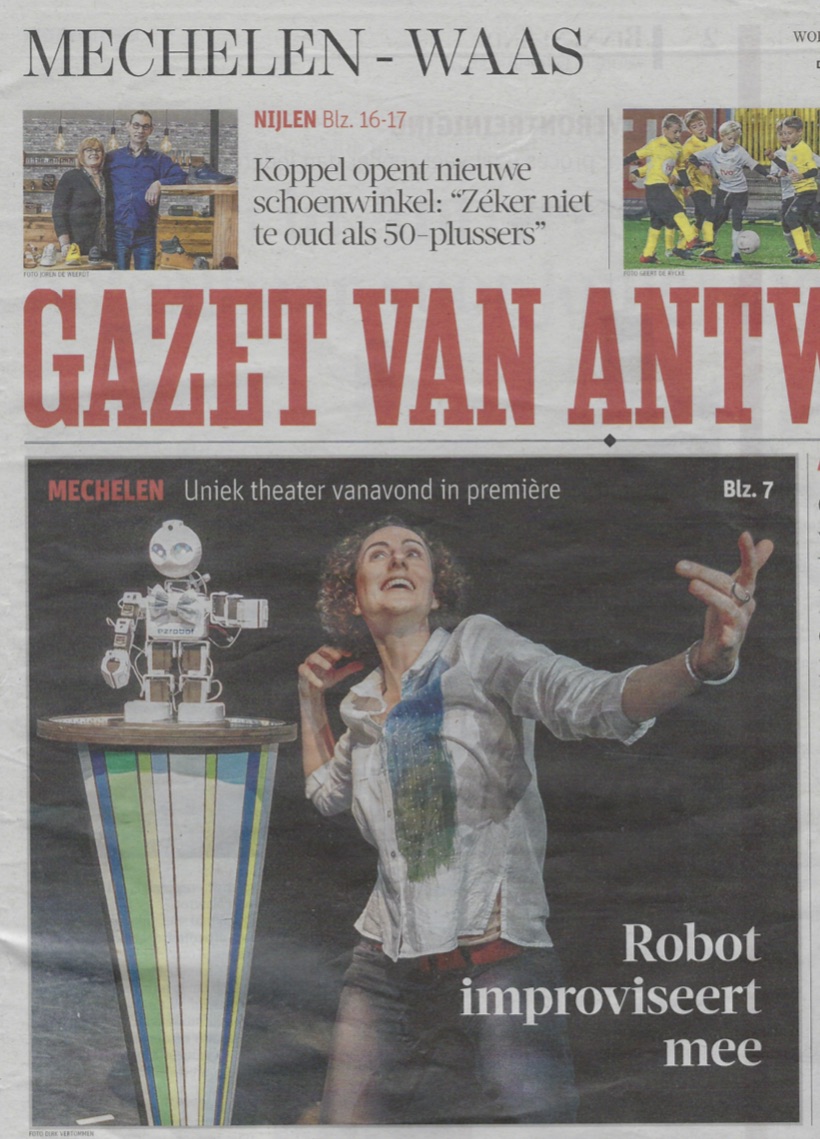
Improbotics is an improv theater show in which an artificial intelligence performs improvised scenes with the human actors. Improbotics Flanders, the Flemish version by ERLNMYR, premiered in February 2020 and still plays for schools, companies and families, in Dutch and in English.
I built the interface and AI technology that runs the show: it gets the AI’s lines, gives them a voice, moves the robot and runs the projector. It started out on GPT-2, almost three years before ChatGPT, and has been rebuilt for new generations of language models since.
Show
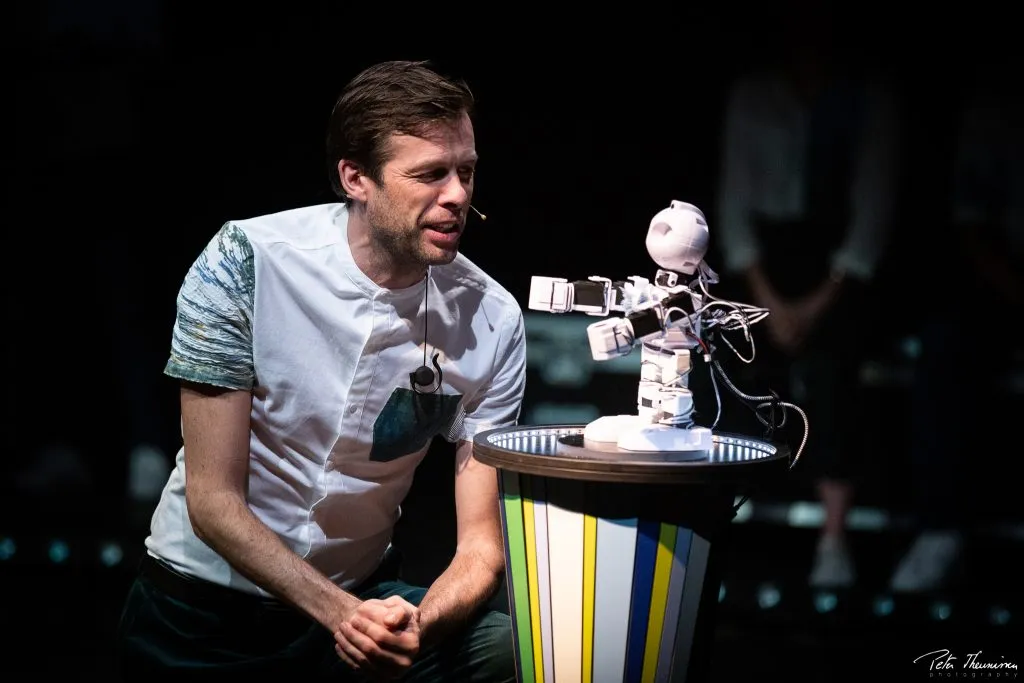
A little robot called Alex presents the show alongside a human presenter. Alex quickly admits that they want to play along, and they are allowed to perform a scene with a human companion. The AI comes up with Alex’s lines during the scene, and Alex says them out loud while the robot moves along.
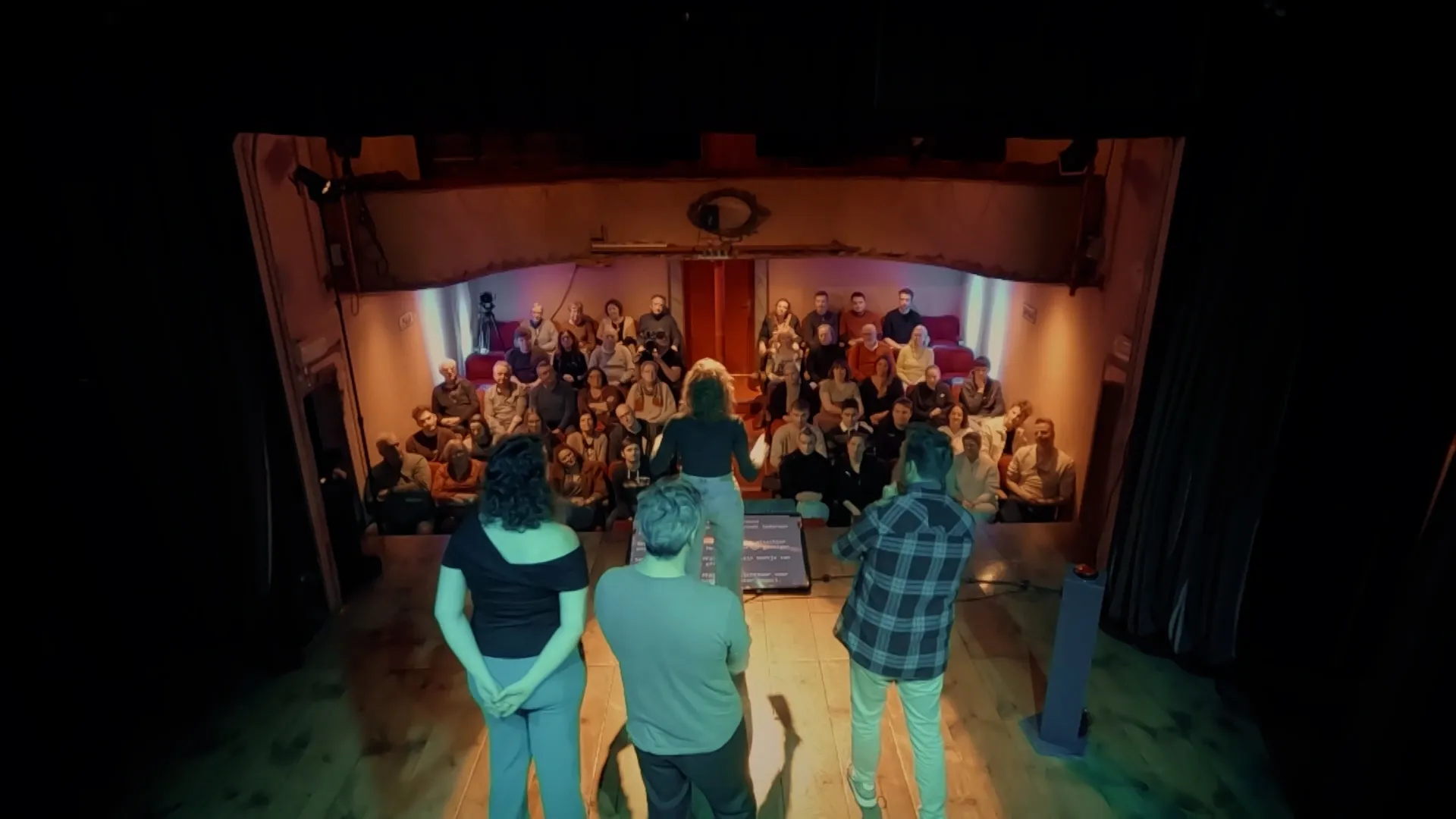
Because their robot body is limited, Alex is granted a human body later in the show. This human-cyborg is only allowed to say the lines the AI whispers through their earpiece. At the show’s end, all human performers carry an earpiece, and the audience has to guess who was controlled by the AI.
More information about the show can be found on the ERLNMYR website. Our show received lots of lovely and positive reactions from the press (see below) as well as from the audience.
International History
The concept was originally worked out by Piotr Mirowski and Kory Mathewson and later got adapted into different versions in the Improbotics UK, Canada, Sweden, and Flanders.
2020: improv with GPT-2
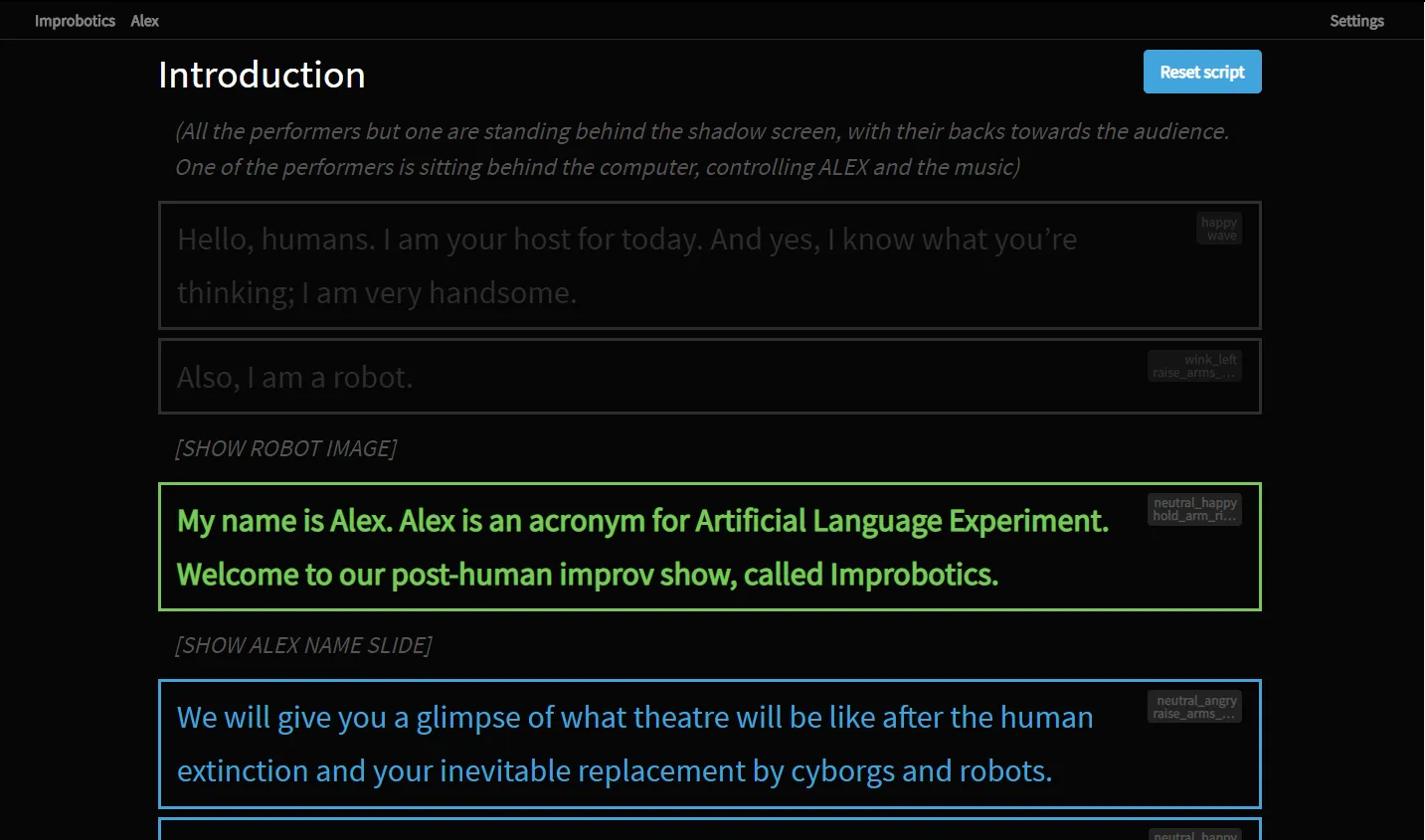
When Improbotics Flanders premiered, the AI behind it was the GPT-2 language model. Improbotics Flanders was also a larger production than its international counterparts, so it needed a new and stable interface. I built one from scratch that controlled the show’s scripted presenter parts, connected to GPT-2 in Dutch and moved the robot. It could easily switch the show’s language, and it aimed to be easy to control for people with a more artistic than technical background.
GPT-2 only knew English, and no Dutch version existed at the time. The project did not have the enormous budget required to train one from scratch, so we translated around it: what the actor said went through Google Translate into English, GPT-2 continued the scene in English, and its lines were translated back into Dutch. This gave astonishingly good results.
GPT-2 also had to run locally, and writing a line took a while. Instead of waiting for one answer, the GPT-2 server wrote candidate lines while the scene went on, and the interface showed them as they came in. The operator typed in what the actor said and picked the best candidate for Alex to say.
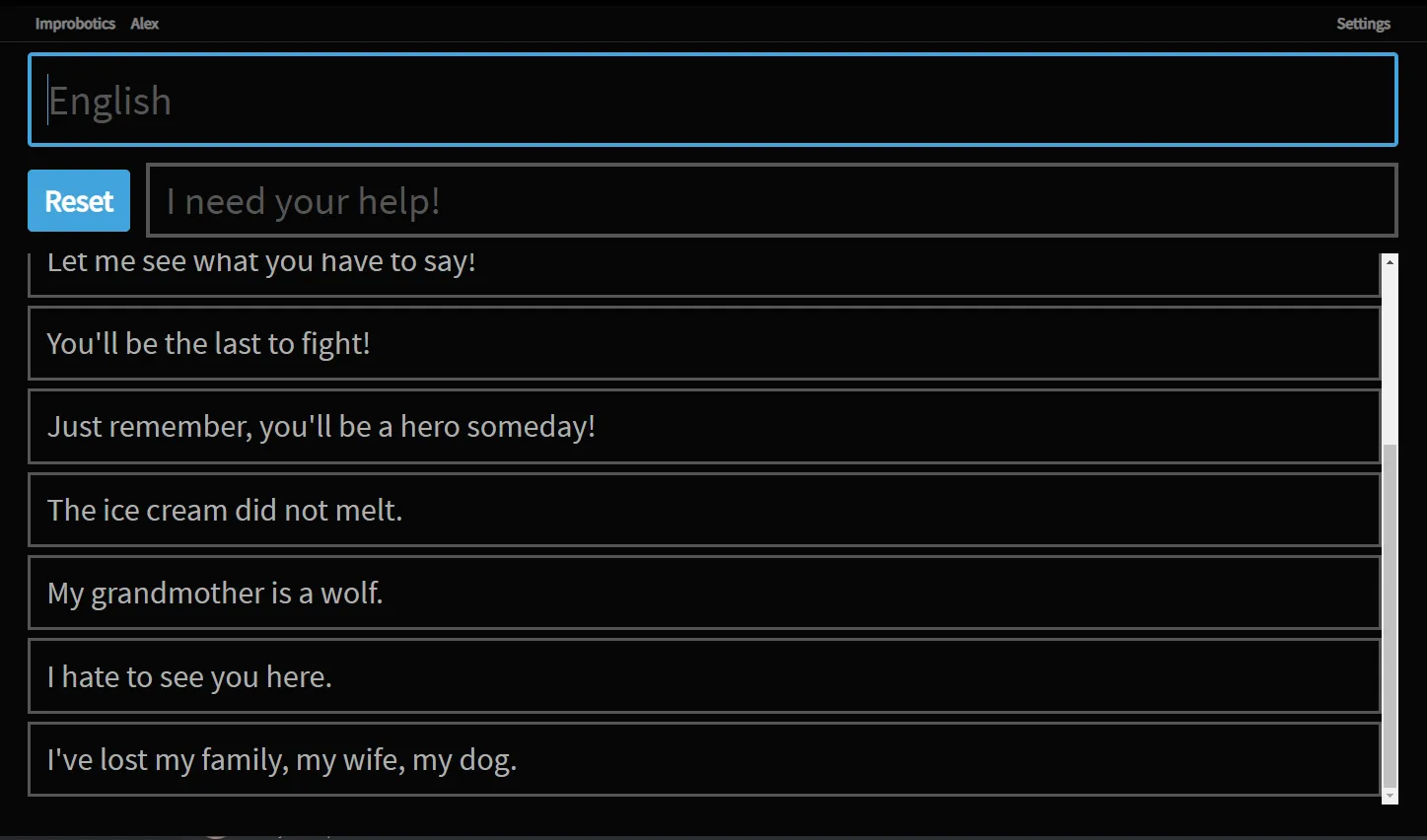
And GPT-2 easily lost the thread of a scene. The improvisers of our group are trained to accept whatever their scene partner offers, so the actors had to make sense of such lines on the spot. In our 2026 paper reflecting on the Improbotics project, we argue that these early, glitchy models often produced more humor through their absurdity than today’s polished models, which even though they produce higher quality scenes, resolve the incongruity too logically.
Controlling the robot
Due to technical limitations of the existing robot controller with the technical setup of the show, we had to develop a new way of moving the robot and its eyes. Together with Sebastiaan “DrSkunk” Jansen, we reverse-engineered the robot’s protocol and created a new way to send eye and body commands to the robot. Today, an improvised line moves the robot the way it is delivered: a line with a [whispers] or [laughs] tag gets a gesture to match.
How it works now
A scene
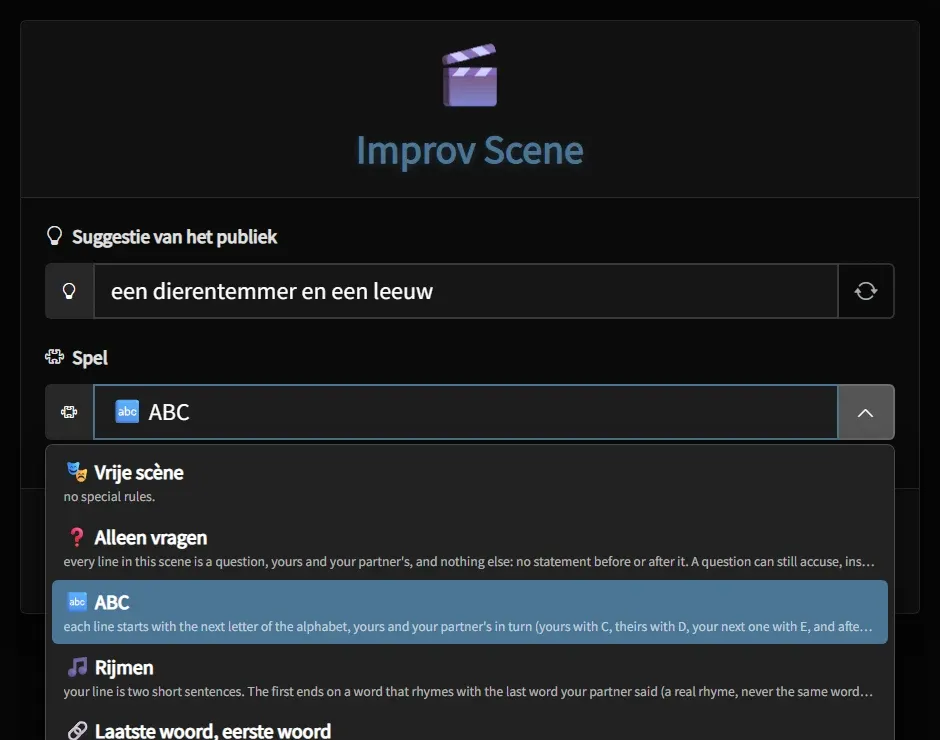
Before a scene, the operator types in the audience’s suggestion, or rolls a random one from the suggestion lists, and picks an improv game.
Then the AI plays along. Speech recognition writes down what the actor says, and a language model writes two options for the AI’s next line in the language of the show. The first one is spoken right away. The prompts ask for lines that people would actually say: short and plain, with audio tags such as [whispers] or [laughs] that the voice acts out.
After each line it says, the AI also prepares what it would say next, in case the actor stays silent. The operator clicks that line when the AI should go on. In the game Pick a Line, the operator picks every line instead, just like in 2020.
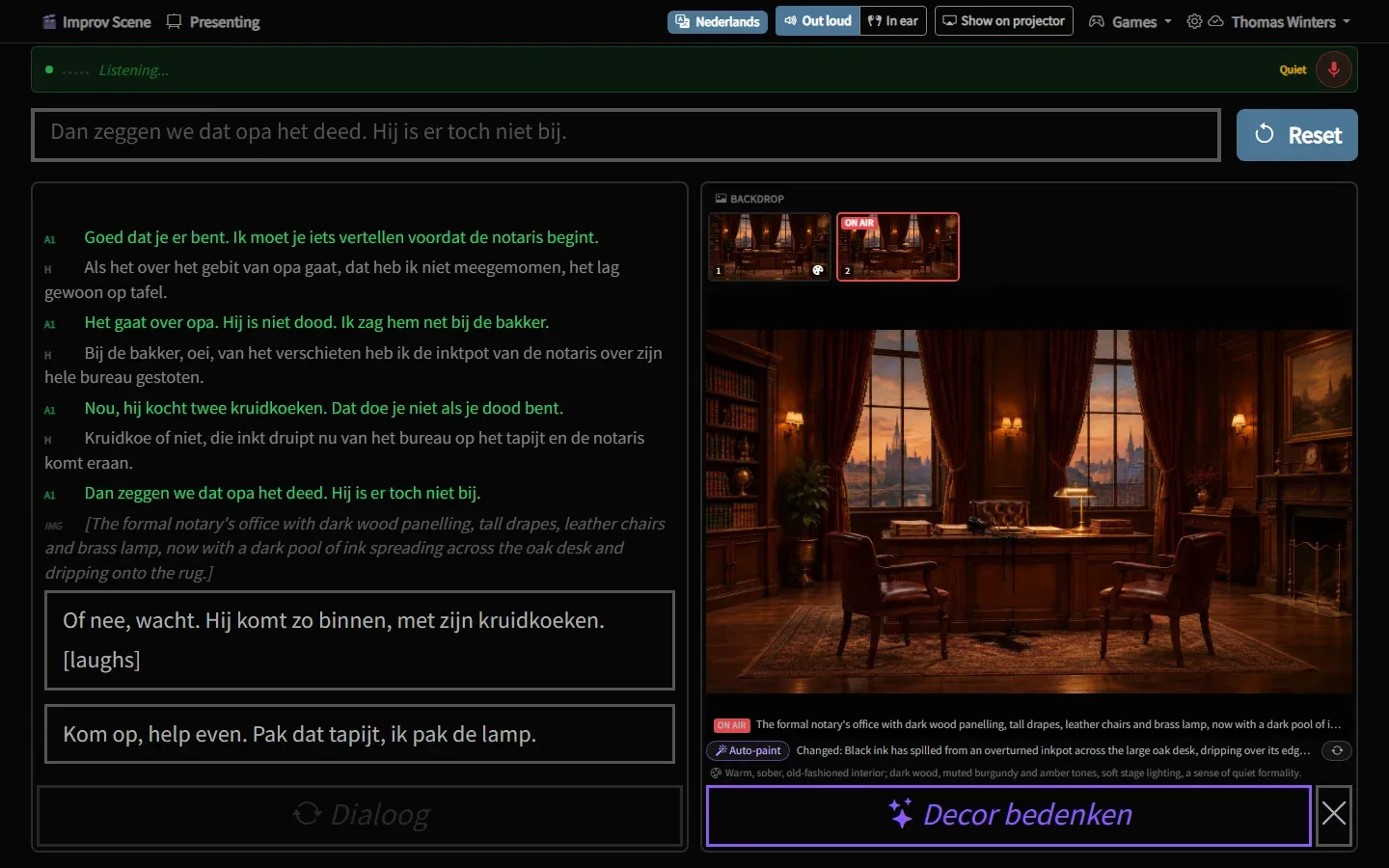
Translated into English, the scene went like this:
AI: Good that you’re here. I need to tell you something before the notary starts.
Actor: If this is about grandpa’s dentures: I didn’t take them. They were just lying on the table.
AI: It’s about grandpa. He isn’t dead. I just saw him at the bakery.
Actor: At the bakery?! Oops. The shock made me knock the notary’s inkwell over his entire desk.
AI: Well, he bought two spice cakes. You don’t do that when you’re dead.
Actor: Spice cakes or not, that ink is dripping off the desk onto the carpet now. And the notary is coming!
AI: Then we’ll say grandpa did it. He isn’t here anyway.
Painted backdrops
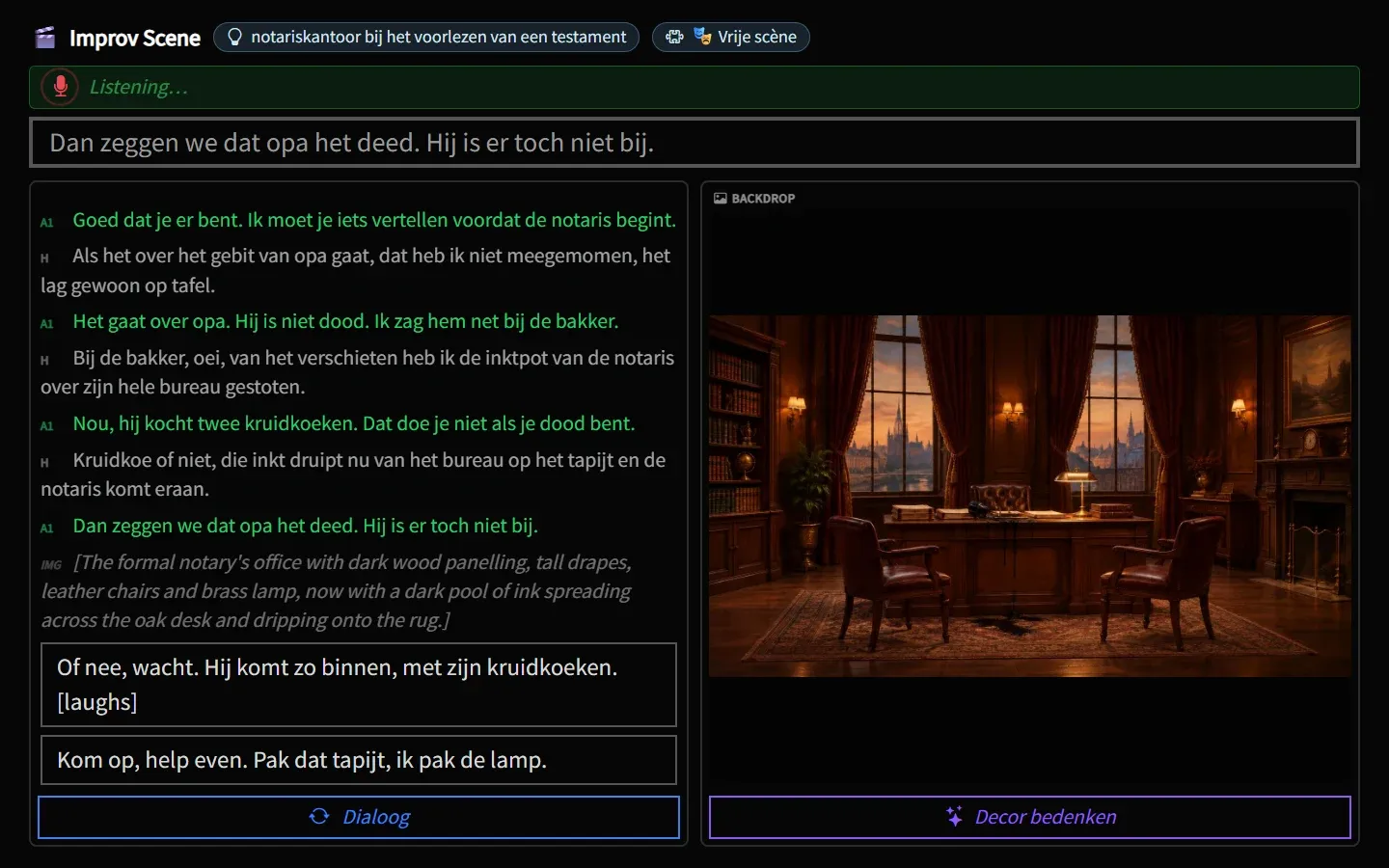
The set gets painted during the scene. A small and fast model, the backdrop director, reads the scene every few lines and decides what the projector should show: keep the current backdrop, bring back an earlier one, paint a new place, or edit the current one when something happens to it. An image model (OpenAI’s GPT Image) then paints it in the look the director picked for the scene, and it goes up on the projector by itself.
When the actor knocked over the notary’s inkwell, the director had the image model paint the spilled ink into the same office.


What the audience sees
The projector shows the backdrops: scene backgrounds, slides during explanations in the show and even views on the controlling interface itself. When the show explains how Alex works, it can also show the running game itself: what the AI heard, the lines it is considering and the backdrop, drawn large for the audience.
Improv games
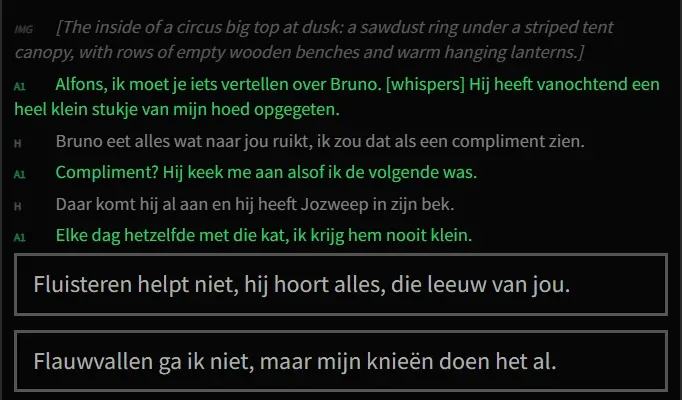
Besides free scenes, the AI plays a set of improv games: questions only, the alphabet game, rhymes, last word first word, one word at a time, the story spine, and the guessing games repair shop and press conference. In the guessing games, the actor doesn’t know the audience’s suggestion, and the AI drops ever clearer hints until they guess it. Each game is a rule in plain language that goes into the prompt, and what a language model can’t keep track of reliably, the interface works out for it.
Try it yourself
The interface runs online at improbotics.thomaswinters.be for anyone with their own API keys. The keys go straight from the browser to OpenAI, Anthropic or ElevenLabs, never through an Improbotics server, and signing in with Google keeps games and settings in your own Google Drive.